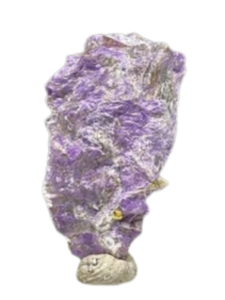
Soft lilac tones and a rare Tasmanian origin give stichtite a calm yet striking look that stands out right away. This unique mineral forms within serpentinite alongside chromite, creating bold natural patterns that catch your attention. In this guide, you will move through its history, where it is found, its physical structure, and its deeper meaning, giving you a clear and simple understanding of a stone that feels easy to see yet holds more depth as you go. If you’re interested in this stone, let’s see what it’s all about.
Stichtite Meaning
Emotional balance: Stichtite may be seen as a stone that connects with emotional balance by softening intense feelings and helping the mind settle into a calmer state. When you hold or focus on it, your thoughts may feel less scattered, and your emotions may move in a smoother, more even flow that feels easier to manage over time.
Compassion and understanding: Stichtite may relate to compassion by opening a deeper sense of understanding toward others and yourself. As you spend time with it, you may notice a shift in how you respond to situations, where reactions feel less harsh and more thoughtful, allowing a softer and more patient mindset to take shape naturally.
Spiritual awareness: Stichtite may be linked to spiritual awareness by helping you feel more connected to your inner thoughts and subtle energy. With regular focus, your awareness may expand in a quiet and natural way, allowing a deeper sense of presence and connection to grow without force or pressure.
History of stichtite
Stichtite is a lilac to light pink carbonate mineral found within serpentinite in Tasmania, mainly in the Dundas mineral field near Zeehan and Queenstown. It was discovered in 1910 at Stichtite Hill in the Zeehan mining district, where it formed as an alteration of chromite within metamorphic serpentinites rich in magnesium and chromium.
The mineral was named after Robert Carl Sticht, a metallurgist and general manager of the Mount Lyell Mining and Railway Company. His work in the region connected closely with the Lyell mining and railway company, which played a key role in the geological exploration of the area. Early records by mineralogist William Frederick Petterd helped document minerals of Tasmania, including this unique gemstone.
Stichtite often appears with serpentine, creating atlantisite, a well known combination used in cabochons, bracelets, and silver pendant jewelry. Its hexagonal structure and association with barbertonite connect it to similar minerals found in Barberton, showing its broader geological presence while remaining strongly tied to its Tasmanian region.
Where is stichtite found?
Stichtite is found mainly in Tasmania, Australia, with its most known locality at Stichtite Hill in the Dundas mineral field near Zeehan. This area sits within the Zeehan mining district, close to Queenstown, where large bodies of serpentinite host the mineral. The stichtite forms inside chromite deposits within these metamorphic rocks, often appearing as a lilac or light pink inclusion mixed with serpentine.
The main source comes from the Dundas mineral field, especially around old workings tied to the Mount Lyell Mining and Railway Company. These deposits are not large scale gemstone mines but smaller geological zones where collectors and mineralogists have identified stichtite within chromite seams. The region around Zeehan and Dundas remains the primary and most reliable location where this gemstone has been recovered.
Outside of Tasmania, similar material has been reported in Barberton, South Africa, where related minerals such as barbertonite occur in serpentinite environments. Even with these occurrences, Tasmania remains the most important and consistent locality for stichtite stone.
Stichtite chakra association
Stichtite is often connected with the crown chakra, which sits at the top of the head and relates to awareness and deeper thought. This stone may support a clearer sense of understanding by helping your mind feel more open and less clouded. As you spend time with it, your thoughts may feel more organized, and your focus may shift toward a broader sense of connection. The soft lilac tone is often linked with higher energy centers, which may help create a quiet sense of inner peace while allowing your awareness to feel more expanded and steady over time.
Stichtite properties
| Property | Description |
|---|---|
| Mineral type | Carbonate mineral |
| Chemical composition | Magnesium chromium carbonate |
| Color | Lilac to light pink to purple |
| Crystal system | Hexagonal |
| Luster | Waxy to pearly |
| Transparency | Opaque to slightly translucent |
| Hardness | 1.5 to 2 on Mohs scale |
| Streak | White |
| Cleavage | Perfect in one direction |
| Fracture | Uneven |
| Density | Around 2.1 to 2.2 |
| Formation | Formed as an alteration of chromite in serpentinite |
| Common association | Found with serpentine, often forming atlantisite |

