Hiddenite often draws attention for its soft green appearance and its connection to early American mineral history. Known as a variety of spodumene, this crystal has roots in North Carolina and later discoveries around the world. Its story blends geology, naming history, and collector interest, making it a mineral that feels both simple and quietly distinctive at the same time. In this guide, let’s explore Hiddenite more in details.
Hiddenite meaning
Emotional awareness: Hiddenite is often linked to emotional awareness that may grow through self observation and honest reflection, allowing your feelings to surface in a way that feels natural/unforced, where sensitivity could be viewed as information rather than something to push aside.
Heart-centered balance: This stone is also commonly associated with heart centered balance that may relate to how emotions and logic interact, creating a sense of internal cooperation where feelings and thoughts can exist together without overpowering one another or needing control.
Personal growth: Hiddenite is frequently connected to personal growth that may unfold gradually, supporting an awareness of patterns, habits, and emotional responses, where change could feel more organic and less driven by pressure over time.
Emotional renewal: Many people associate it with an emotional renewal that may feel restorative, especially during those periods of transition. This could allow your emotional energy to reset in a calmer way that supports openness to new emotional experiences without force or expectation.
Hiddenite pricing
Hiddenite pricing often varies based on size and overall appearance much like all gemstones/crystals, etc. Smaller pieces are commonly seen in the $20 to $80 range and are often chosen for simple displays or casual collections. Medium sized stones, on the other hand, usually fall between $80 and $250 and tend to show more noticeable color or clarity. Larger specimens are often priced from $250 to $800 and are picked for their stronger visual presence. Finer or less common Hiddenite pieces frequently appear in the $800 to $2500 range, especially when the stone stands out within a collection.
Where is Hiddenite found?
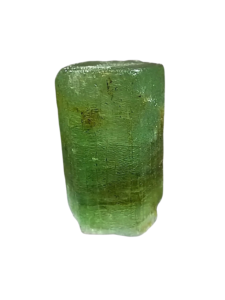
North Carolina USA: Hiddenite is most closely associated with North Carolina, particularly in Alexander County where the town of Hiddenite is located. This area includes the historic Emerald Hollow Mine and nearby pegmatite zones where the stone has been recovered for many years.
Brazil: Brazil is another known location where Hiddenite has been found, especially in regions with lithium rich pegmatites. Stones from Brazil are often associated with areas already known for producing spodumene and other related minerals.
Afghanistan: Hiddenite has also been reported in parts of Afghanistan, mainly from mountainous regions with complex pegmatite systems. These locations are known for producing a range of gem materials, with Hiddenite appearing in smaller quantities.
Madagascar: Lastly, Madagascar is sometimes mentioned as a source of Hiddenite, with material coming from pegmatite deposits that host a variety of gem minerals. Stones from this region are typically found alongside other spodumene varieties and related crystals.
What is Hiddenite?
Hiddenite is a crystal and mineral known as a green variety of spodumene within the silicate family, valued as a gem by collectors for its emerald green appearance that can range from very light yellow to deeper green tones and sometimes even colorless material.
It was first identified in North Carolina, specifically in Alexander County near the area now called Hiddenite, with early discoveries tied to White Plains during the late 1800s. The stone was named after William Earl Hidden, a mineralogist who worked with emerald exploration and later had the mineral renamed in 1879 to reflect his involvement. Hiddenite crystals are chemically related to kunzite, another variety of spodumene named after Kunz, though hiddenite is associated with green coloring linked to chromium rather than pink tones.
As a gem, hiddenite is usually cut for collectors rather than mass jewelry use, with its value connected to clarity, size, and color expression rather than uniform commercial grading.
Hiddenite properties
| Hiddenite physical property | Details |
|---|---|
| Mineral name | Hiddenite |
| Mineral group | Spodumene |
| Chemical formula | LiAlSi2O6 |
| Mineral class | Silicate |
| Crystal system | Monoclinic |
| Typical color | Green to yellow green |
| Luster | Vitreous |
| Transparency | Transparent to translucent |
| Streak | White |
| Mohs hardness | 6.5 to 7 |
| Cleavage | Distinct cleavage in two directions |
| Fracture | Uneven to splintery |
| Tenacity | Brittle |
| Specific gravity | About 3.1 to 3.2 |
| Refractive index | About 1.66 to 1.68 |
| Birefringence | Moderate to strong |
| Pleochroism | Often noticeable, green tones can shift with viewing direction |
| Optical character | Biaxial |
| Typical crystal habit | Elongated prismatic crystals, sometimes with striations |

