Gyrolite might not be a household name, but once you see it, you do not forget it. This uncommon mineral species stands out with its soft nodular growth, layered crystal structure, and fascinating crystal chemistry tied to hydrous calcium silicate systems. Formed during hydrothermal activity and studied in respected mineral journals, the gyrolite mineral offers more depth than most people expect from a quiet-looking stone. In today’s guide, let’s take a dive and see what it’s all about.
Gyrolite meaning
Emotional release: Gyrolite is often connected with emotional clearing and softening heavy feelings that build over time. When you work with this stone, it may help you sort through old thoughts without feeling overwhelmed. Its energy is commonly linked to easing tension in the heart space, allowing you to process experiences in a calmer and more balanced way while feeling more open to change.
Inner peace: Many people associate gyrolite with a quiet sense of peace that settles the mind. It may support slower thinking and reduce mental clutter when life feels rushed. By keeping this stone nearby, you may notice a smoother flow of thoughts and a lighter emotional atmosphere that feels less pressured and more centered throughout the day.
Spiritual meaning: Gyrolite is often viewed as a stone that supports spiritual growth in a subtle and natural way. Its presence may deepen your awareness of your own energy and the space around you. Over time, it may help you feel more connected to your intuition while creating a sense of clarity that feels grounded rather than overwhelming.
Energy renewal: This stone is also linked with refreshing your personal energy when you feel drained or mentally tired. Gyrolite may help clear lingering negativity and create a lighter emotional field. As you spend time with it, you may experience a renewed sense of motivation and a smoother emotional rhythm that feels easier to maintain.
Where is Gyrolite found?
India: India is one of the most important and widely recognized sources, especially within the Deccan Traps of Maharashtra. Popular collecting areas include the Pune, Nashik, and Jalgaon districts, along with quarry sites near Mumbai. It forms inside rounded gas cavities within ancient basalt flows, developing as mineral-rich fluids circulated through volcanic rock during cooling events that took place millions of years ago.
Iceland: Iceland is another well-known source due to its extensive volcanic terrain. Notable areas include Berufjörður in East Iceland and regions along the Reykjanes Peninsula near Reykjavík. Here it forms within basalt lava flows and coastal cliffs, growing inside vesicles created by trapped gases in cooling lava where hydrothermal fluids later deposited secondary minerals.
United States: In the United States, popular area include the basalt quarries of Paterson and Prospect Park in New Jersey, which are historically significant for zeolite minerals. Additional occurrences are found within the Columbia River Basalt Group in Oregon and in volcanic formations in parts of California. These deposits developed inside cavities within trap rock and other basalt formations linked to ancient lava flows.
Scotland: Scotland, particularly the Isle of Skye, is known for basalt formations associated with historic volcanic activity. Specimens occur within cavities in layered basalt rock, formed as mineral-bearing fluids moved through fractures and voids in solidified lava. The Isle of Skye remains the most recognized Scottish locality for collectors.
Northern Ireland: Northern Ireland is known for occurrences within the Antrim basalt deposits, part of a large volcanic province. In this region, it forms inside amygdaloidal basalt where gas pockets were later filled by circulating mineral-rich fluids. Weathered cliffs and quarry exposures have produced collectible material from these deposits.
Japan: Japan has reported finds in volcanic regions such as Hokkaido, where basaltic environments provided suitable conditions for mineral formation. It develops inside cavities within volcanic rock created by cooling lava flows, similar to other global basalt-hosted deposits, and is typically associated with other secondary minerals formed through hydrothermal processes.
Is it rare?
Gyrolite is not considered extremely rare on a global scale, but it is not commonly seen in everyday crystal shops. It forms in specific volcanic environments, mainly inside basalt cavities, which limits where it can develop. While several countries produce it, quality specimens with well-formed spherical patterns or attractive crystal structure are less common than typical zeolite minerals.
Most deposits occur in restricted basalt provinces, so supply depends heavily on active quarrying or natural exposures. In places like India and Iceland, it appears more regularly, but outside those regions it becomes harder to find. Larger, aesthetic pieces with clean formation are more limited and therefore more sought after by collectors.
Overall, it sits somewhere between uncommon and moderately scarce, especially when compared to more widespread minerals like quartz or calcite.
What is it?
Gyrolite is an uncommon mineral species classified as a hydrous calcium silicate hydrate within the broader group of zeolite minerals. The gyrolite mineral is composed mainly of hydrated calcium, silicon, and oxygen, forming a sodium calcium silicate hydrate framework with layered, lamellar features. Its crystal structure and crystal chemistry are complex, built from sheets that stack and connect in repeating patterns, giving insight into its detailed crystal chemistry described in mineralogical literature such as Mineralogical Magazine and American Mineralogist.
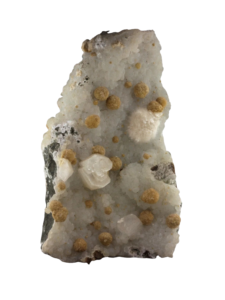
Gyrolite often forms nodular masses, and gyrolite usually forms individual nodules with radiate internal patterns that develop as the mineral begins to crystallize. Much gyrolite forms inside of volcanic bubbles called vesicles or within vugs created in basaltic rock during hydrothermal processes. The formation of gyrolite during hydrothermal conditions results in rounded growths that may appear as soft spheres or layered concretions. It is closely related to other hydrous calcium minerals such as tobermorite and is studied for its role in understanding hydrothermal synthesis and structural relationships within calcium silicate hydrate systems.
Gyrolite price
Gyrolite prices can vary widely depending on size, quality, and aesthetic appeal. Small pieces that are less defined or more common in appearance often sell in the $10–$40 range. Mid-range specimens with clearer structure or unique formation typically fall between $40–$120. Larger or more distinctive pieces that show strong crystal form and attractive surfaces can reach $120–$300. Lastly, exceptional specimens that are well-formed, visually striking, or from notable localities sometimes sell for $300–$600 or more.
Gyrolite properties
| Property | Details |
|---|---|
| Mineral class | Silicate mineral |
| Silicate type | Phyllosilicate (sheet silicate) |
| Chemical formula | Ca₂Si₃O₇(OH)₂·H₂O |
| Crystal system | Orthorhombic |
| Crystal habit | Radiating spheres, rosettes, fibrous to bladed aggregates, crusts in cavities |
| Color | White, colorless, pale gray, pale green |
| Luster | Vitreous to pearly, sometimes silky on fibrous surfaces |
| Transparency | Transparent to translucent, sometimes nearly opaque in dense aggregates |
| Streak | White |
| Cleavage | Perfect to good in one direction (can appear as layered splitting in aggregates) |
| Fracture | Uneven to splintery |
| Mohs hardness | 4 to 5 |
| Specific gravity | ~2.3 to 2.4 |
| Typical environment | Secondary mineral in basalt cavities and fractures |
| Common associations | Zeolite minerals, apophyllite, prehnite, calcite, okenite, tobermorite |

