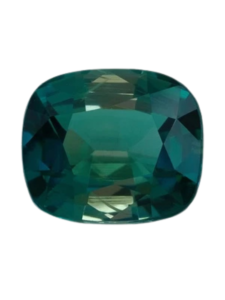
Grandidierite is one of those gemstones that instantly pulls your attention, not just because of its deep blue-green color but because so few people have ever seen one in person, making it feel almost hidden from the world. As you look closer, the way light shifts through the stone and reveals different tones gives it a look that stands apart from most other gemstones, adding to its quiet appeal. Its rarity, combined with its unique structure and color range, has made grandidierite one of the most talked about gems among collectors who are always searching for something truly uncommon. In today’s guide, let’s learn more about it, from its metaphysical meanings to properties.
Grandidierite meaning
Mental clarity: Grandidierite may be viewed as a stone that supports clear thinking, where your mind feels more organized and less scattered, allowing you to sort through ideas with better focus while staying present in what you are doing without feeling pulled in too many directions.
Balance and control: Grandidierite may be linked to emotional steadiness, where your reactions feel more controlled and less intense, helping you understand your feelings at a deeper level while moving through stressful moments with a calmer and more grounded mindset.
Honest communication: It may even be connected to truthful expression, where your words feel more natural and direct, allowing you to share thoughts clearly while staying true to what you believe, which may help reduce confusion and bring more clarity to conversations.
Grandidierite spiritual meaning: Grandidierite may be tied to a deeper level of awareness, where your thoughts feel more connected to your inner self, helping you reflect on your direction in life while gaining a clearer sense of purpose and personal growth over time.
What is Grandidierite?
Grandidierite is a rare mineral known for its striking blue-green appearance and strong pleochroism, where the color may shift between dark blue-green, dark green, and even near colorless depending on how the gem is viewed, giving each grandidierite a unique visual depth.
First identified in 1902 and named after Alfred Grandidier, a French explorer, grandidierite is valued as both a mineral specimen and a gemstone, with gem-quality pieces being extremely limited, which adds to the overall rarity seen across the gem market today.
Most grandidierite forms as translucent to opaque material, though higher grade gemstone examples may be cut into facet shapes or polished into cabochons, with each grandidierite piece showing a rich tone that stands out among other gemstones due to its natural color and clarity variations.
Grandidierite has a hardness of about 7.5 on the Mohs scale, giving the gem moderate durability for jewelry use, though care may still be needed due to its cleavage, especially when cut into higher karat gemstone pieces that aim to highlight the natural beauty of grandidierite.
The rarity of grandidierite makes it one of the more sought after gemstones, where each gem carries a distinct identity shaped by its mineral structure, color range, and the way light moves through the stone.
Where is Grandidierite found?
Andrahomana: This area is known for some of the earliest documented grandidierite discoveries, where the mineral was first studied and described, with material often appearing in smaller crystals that may range from translucent to more opaque forms.
Tranomaro: This region has produced some of the more notable grandidierite pieces, where deeper blue-green tones may be seen along with improved clarity, allowing select material to be shaped into gemstones when quality is high enough.
Madagascar: The broader southern part of this country remains the primary source of grandidierite, where most known deposits are concentrated, and where both mineral specimens and rare gem-quality material continue to be found in limited quantities.
Sri Lanka: Grandidierite here is found in very small amounts, often mixed within gem-bearing gravels, where pieces are usually lighter in tone and less consistent in size compared to material from Madagascar.
Namibia: Occurrences in this region are uncommon, with grandidierite appearing in isolated geological settings, where most pieces are collected as mineral specimens rather than cut into gemstones.
Malawi: This location has produced limited grandidierite findings, where the material is not widely distributed and is rarely seen in the market, often remaining in rough mineral form.
Suriname: Small and infrequent discoveries have been noted, where grandidierite appears in minor deposits that are not heavily explored or developed for gemstone production.
Japan: Rare occurrences exist here, typically as small crystal formations within host rock, where the material is more often kept as a mineral sample rather than used for jewelry.
How much does Grandidierite cost?
Grandidierite may vary widely in price based on clarity, color depth, and how much light passes through the stone. Lower grade pieces that appear opaque or heavily included may sell for about $20–$200 total, while more translucent material with visible inclusions may range from $50–$500 per carat as the blue-green tone becomes easier to see.
As quality improves, grandidierite with richer color and better transparency may fall between $500–$3,000 per carat, especially when cut into small gemstones, while higher end faceted pieces with strong color and fewer inclusions may reach $8,000–$20,000+ per carat. Rarer top tier stones with very clean appearance and vivid color may exceed $20,000–$30,000+ per carat due to limited supply.
Grandidierite properties
| Property | Grandidierite Details |
|---|---|
| Mineral type | Magnesium aluminum borosilicate |
| Color | Blue-green, greenish blue, dark green, dark blue-green, and rare colorless tones |
| Hardness | 7.5 on the Mohs scale |
| Luster | Vitreous to glassy |
| Transparency | Transparent, translucent, or opaque depending on quality |
| Crystal system | Orthorhombic |
| Cleavage | Good cleavage in one direction |
| Fracture | Uneven to conchoidal |
| Streak | White |
| Specific gravity | About 2.85 to 3.00 |
| Refractive index | About 1.58 to 1.64 |
| Pleochroism | Strong, often showing blue-green, green, and nearly colorless directions |
| Common cuts | Faceted stones, cabochons, and rough mineral specimens |

