Gibbsite is one of those minerals that looks simple at first but has a lot going on beneath the surface. From its layered crystal structure to its role in alumina, bauxite, and mineral research, it sits at the center of weathering, chemistry, and mineral science in ways that surprise many people. In today’s guide, we’re going to explore Gibbsite more in detail, from its meaning to where it’s found.
Gibbsite meaning
Emotional clarity: Gibbsite may be seen as a stone connected to sorting through emotional weight in a calm, grounded way, where feelings that feel tangled may slowly feel easier to recognize and sit with. Its presence may support noticing emotional patterns without pressure, allowing space for awareness to unfold naturally over time.
Mental softening: Gibbsite may relate to mental clarity that feels relaxed rather than forced, where thoughts that feel crowded may begin to separate and feel less heavy. This stone may be associated with easing mental tension so reflection feels smoother, giving the mind room to process ideas without urgency or strain.
Inner acceptance: Gibbsite may carry a meaning tied to self-acceptance on a quiet level, where personal traits and emotions may be viewed with more understanding instead of resistance. This energy may support sitting with who you are in the present moment, allowing growth to happen naturally without pushing or controlling the process.
Gibbsite spiritual meaning
Quiet awareness: Gibbsite may be linked to a form of awareness that feels calm and observant, where inner experiences are noticed without needing to change or fix them. This spiritual meaning may relate to allowing thoughts and feelings to surface naturally, creating space for reflection that feels open and unforced.
Personal truth: Gibbsite may carry a spiritual meaning connected to recognizing personal truth in a soft, honest way, where inner beliefs and values are seen more clearly over time. This stone may be associated with accepting what feels true on a deeper level, without pressure to define or label the experience.
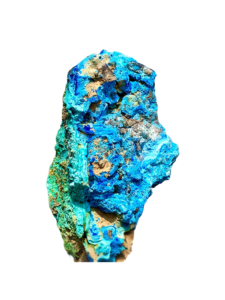
Where is Gibbsite found?
United States: Gibbsite is found in several areas across the United States, especially in states known for aluminum-rich deposits. Notable occurrences come from Arkansas, Alabama, and Georgia, where it appears in bauxite deposits formed through long-term weathering of aluminum-bearing rocks.
Brazil: Brazil is one of the most well-known countries for gibbsite, with material commonly coming from large bauxite regions. Deposits are found in Pará and Minas Gerais, where gibbsite forms as part of laterite profiles and is often associated with other aluminum minerals.
Australia: Australia hosts significant gibbsite occurrences, particularly within major bauxite mining regions. Locations in Western Australia and Queensland are known for producing gibbsite-rich material, often found close to the surface due to intense weathering conditions.
Europe: In Europe, gibbsite has been reported from areas in France, Germany, and Hungary. These occurrences are usually smaller and are often found alongside other secondary aluminum minerals within altered limestone or bauxite zones.
Asia and Other Regions: Gibbsite is also found in countries such as India, China, and Indonesia, where warm climates support the formation of aluminum-rich soils. Additional occurrences are known from Jamaica and parts of West Africa, where gibbsite appears within extensive bauxite deposits shaped by long-term tropical weathering.
What is Gibbsite?
Gibbsite is an aluminum hydroxide mineral that sits within the broader group of hydroxide minerals and oxides and hydroxides, often discussed alongside bayerite, doyleite, and nordstrandite as closely related forms of gibbsite. Its crystal structure of gibbsite is based on octahedral sheets of aluminum ions bonded with hydroxyl groups, creating a neutral sheet arrangement with a distinct interlayer spacing that influences stability of gibbsite and its physical properties.
From a mineralogical perspective, gibbsite is a fine-grained to coarse-grained material that may appear as tabular crystals of gibbsite, compact masses, or fine aggregates, with colouration ranging from colorless to white or muted tones. The structure of gibbsite has been examined through diffraction and mineral information studies, including first-principles study of the OH-stretching modes of gibbsite, which focus on ion behavior, cationic bonding, and aluminate interactions within the lattice.
Gibbsite is considered a constituent of bauxite and plays a role in alumina and aluminum oxide production through the Bayer process, where caustic soda interacts with aluminate species. In scientific literature, it is often compared with diaspore and boehmite, as well as brucite and corundum, to understand chemical weathering, lateritic formation, hydrothermal influences, metamorphic transitions, and hypothetical structure calculated from synthetic gibbsite research. Named by John Torrey in honor of George Gibbs, gibbsite remains important to mineralogists, mineral specimens, mineral collections in the USA, and the finest mineral collection studies focused on clay minerals, kaolinite associations, and weather-driven mineral evolution.
Gibbsite properties
| Property | Gibbsite |
|---|---|
| Chemical formula | Al(OH)3 |
| Mineral class | Hydroxide |
| Crystal system | Monoclinic |
| Common crystal habit | Tabular crystals, platy aggregates, earthy to massive forms |
| Luster | Vitreous to pearly, sometimes dull when massive |
| Transparency | Transparent to translucent, opaque when earthy |
| Color | Colorless, white, gray, pale green, pale blue, yellowish, brownish |
| Streak | White |
| Mohs hardness | 2.5 to 3.5 |
| Specific gravity | About 2.3 to 2.4 |
| Cleavage | Perfect in one direction, commonly described as basal |
| Fracture | Uneven to splintery |
| Tenacity | Brittle |
| Optical character | Biaxial |
| Fluorescence | Some specimens show weak fluorescence, many show none |

