Gaspeite stands out as a green gem that often catches attention the moment it is seen, known for its vivid color, uncommon nature, and strong connection to nickel rich mineral systems. This rare mineral moves between the worlds of geology, gemstone collecting, and jewelry design, where its appearance and structure make it instantly recognizable. From polished cabochons to natural material used in inlay work, gaspeite continues to draw interest for its unique character, physical traits, and the quiet depth it brings to both collections and finished pieces. In today’s guide, let’s dive deep and see what Gaspeite is all about.
Gaspeite meaning
Emotional balance: Gaspeite is often connected with emotional balance in a way that feels natural and unforced, where emotions may feel easier to process as they arise rather than building up quietly over time. Feelings may move through with less inner tension, creating a calmer emotional rhythm that supports patience, reflection, and a clearer emotional state during everyday moments.
Self awareness: Gaspeite is commonly associated with self awareness, where inner patterns may feel more noticeable without feeling heavy or overwhelming, allowing thoughts, reactions, and habits to come into focus at a comfortable pace. This awareness may support clearer recognition of emotional triggers and personal boundaries, creating space for thoughtful responses instead of automatic reactions.
Heart centered energy: It is often linked to heart centered energy, where emotional openness may feel more natural and sincere, supporting honest expression without emotional strain. Connections with others may feel more grounded and authentic, allowing emotional exchanges to flow with clarity while maintaining a sense of emotional stability and inner reassurance.
Gaspeite spiritual meaning
Awareness: Gaspeite is often associated with spiritual awareness that feels calm and grounded, where inner beliefs and values may feel easier to reflect on without pressure or emotional noise. Spiritual thoughts may flow more clearly, allowing a deeper sense of trust in personal direction while maintaining emotional clarity, balance, and a feeling of connection that feels natural and quietly supportive.
Where is Gaspeite found?
Australia: Gaspeite is most commonly associated with Australia, where it is linked to nickel rich deposits in Western Australia. The area around the Kambalda region is frequently mentioned, along with nearby mining zones where nickel bearing material has historically been extracted and later associated with gaspeite occurrences.
Canada: It has also been reported in Canada, particularly in Quebec. The Gaspé Peninsula is often referenced due to its geological setting and nickel related mineral activity, which is closely tied to how gaspeite appears within the region’s mineral landscape.
United States: In the United States, gaspeite has been noted in limited amounts within Nevada. These occurrences are usually connected to nickel bearing environments rather than large scale gemstone deposits, making the material less common and more localized.
Is it rare?
Gaspeite is often considered rare due to its limited occurrence and the specific nickel rich conditions needed for it to form. It is not widely distributed, and most material appears in small quantities rather than large deposits. Because it is closely tied to certain mining regions and specific geological settings, availability may feel inconsistent, with quality pieces appearing less frequently compared to more common green minerals.
Gaspeite price
Gaspeite prices for small tumbled stones, beads, and tiny cabochons are often seen in the range of $3 to $25. These pieces are usually lightweight and simple, making them some of the most accessible options when gaspeite appears on the market. Mid range gaspeite such as larger cabochons or medium rough pieces is commonly priced between $40 and $150. Size, surface quality, and overall appearance tend to influence where a piece falls within this range. Lastly, larger rough chunks or standout cabochons are often listed from $250 to $600, especially when the material is visually clean and well sized. Exceptional specimens or unusually large pieces may be priced higher depending on availability and demand.
Where is Gaspeite?
Gaspeite, also written as gaspéite, is a rare nickel carbonate mineral with the chemical formula NiCO3 and is classified within carbonate minerals as a member of the calcite mineral group. In mineralogy, gaspeite is described as a rare nickel carbonate mineral and is often considered extremely rare due to the specific nickel rich conditions required for its formation. It develops as a secondary mineral through oxidation processes involving nickel rich ore minerals such as pentlandite, millerite, and kambaldaite, often forming hydrothermally within ultramafic and nickel rich geologic environments.
Gaspeite typically appears in massive material, crusts, or veining rather than well formed crystals, and inclusions are common. Its crystal structure places it within a solid solution series that may include magnesium and iron, which can influence physical appearance and density. The mineral shows birefringence and a refractive index that may range from about 1.61 to 1.83 when measured with a refractometer. Effervescence may occur when exposed to hydrochloric acid, and some material may display weak fluorescence. On the Mohs hardness scale, gaspeite usually falls between 4.5 and 5.
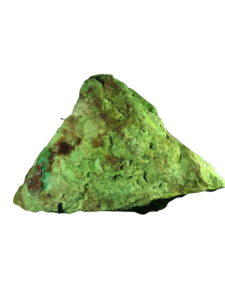
As a gemstone, gaspeite is known for its bright green to apple green color, sometimes compared visually to chrysoprase, malachite, turquoise stones, or green agate. It is most often cut and polished into cabochons, tumbled stones, or inlay, and is commonly used in southwestern style jewelry, sterling silver settings, and native American designs, frequently seen at gem and mineral show displays alongside other green gemstones and lapis lazuli.
Gaspeite properties
| Property | Gaspeite |
|---|---|
| Mineral group | Carbonate, calcite group |
| Chemical formula | NiCO3 |
| Crystal system | Trigonal |
| Typical form | Massive, nodular, botryoidal, crusty coatings, crystal aggregates |
| Color | Pale green to bright green, often with brown or darker matrix |
| Streak | Yellow green |
| Luster | Vitreous to dull |
| Transparency | Translucent to opaque, clearer pieces are uncommon |
| Mohs hardness | 4.5 to 5 |
| Cleavage | Good in one direction |
| Fracture | Uneven |
| Specific gravity | About 3.7, sometimes a bit higher depending on composition |
| Magnetism | Weakly magnetic in some material |
| Reaction to acid | Carbonate reaction, can dissolve in hydrochloric acid |
| Common setting | Nickel rich weathered zones and altered nickel bearing rocks |

