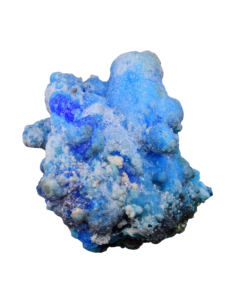
Electric blue chalcanthite immediately stands out among copper minerals for its striking appearance and unusual formation. This hydrated copper sulfate forms in oxidized copper deposits, often near old mining districts where moisture and exposure shape its crystal growth. Known for vivid blue crystals, crusts, and prismatic forms, chalcanthite attracts collectors while remaining chemically unstable and water soluble. Its beauty, toxicity, and tendency to dissolve and recrystallize make it one of the more visually intense yet fragile mineral specimens encountered. In this guide, let’s take a gander at what Chalcanthite is all about.
Chalcanthite meaning
Mental clarity: Chalcanthite is often linked with mental clarity, where its presence may be viewed as helping thoughts feel less scattered and more organized. This meaning often centers on observation and reflection, allowing the mind to notice patterns, ideas, and details without feeling rushed, as everything flows more smoothly together.
Emotional release: Another metaphysical meaning tied to chalcanthite relates to emotional release, where it is often associated with allowing emotions to surface, move through, and soften over time. This perspective focuses on recognition rather than control, giving space for emotional experiences to be acknowledged without being held tightly or pushed away.
Energetic awareness: Chalcanthite is also commonly connected with energetic awareness, especially around sensing subtle shifts in personal energy and environment. This meaning often centers on awareness rather than action, where noticing changes, sensitivities, and inner signals may feel more accessible, leading to a deeper understanding of how internal and external energies interact.
Chalcanthite spiritual meaning
Perception: Chalcanthite is often connected with spiritual awareness that centers on perception and inner recognition rather than effort or control. This meaning tends to focus on noticing subtle spiritual impressions, emotional signals, and inner shifts as they arise, allowing spiritual insight to feel more present through observation, patience, and natural unfolding over time.
Where is Chalcanthite found?
United States: In the United States, chalcanthite is most often seen in copper mining regions where surface exposure allows it to form naturally. States such as Arizona, Utah, Nevada, New Mexico, and California are commonly associated with it, especially around abandoned copper mines, exposed tunnels, and mine drainage areas.
Europe: Throughout Europe, chalcanthite is linked to long-established copper mining districts. It is often noted in countries like Spain, Italy, Germany, and the United Kingdom, where historic mine workings and surface exposure provide suitable conditions for visible crystal growth.
South America: In South America, chalcanthite is closely connected with major copper-producing regions. Chile and Peru are frequently associated with it, particularly in arid mining zones where evaporation allows chalcanthite to appear on rock surfaces and mine structures.
Australia: Australia is another location where chalcanthite is observed, mainly near copper deposits and old mine sites. It is often seen in dry regions where mineral-rich waters reach the surface and crystallize rather than dispersing into surrounding rock.
Africa: In Africa, chalcanthite is commonly associated with copper-rich areas in countries such as Namibia and Zambia. It is typically found near exposed copper workings and mine drainage zones where surface conditions allow it to develop visibly.
Russia: Russia also has reported occurrences of chalcanthite, usually near copper mining areas and oxidized zones. These locations often involve surface exposure where mineral solutions interact with air and solidify over time.
Is it rare?
Chalcanthite is generally viewed as uncommon rather than truly rare, largely because it forms under very specific surface conditions. It tends to appear in copper mining areas where moisture, exposure, and evaporation come together, which limits how often it is naturally seen. Even in places where copper is abundant, chalcanthite does not consistently remain stable, as changes in humidity or contact with water often cause it to dissolve, making lasting specimens less frequently encountered.
What is Chalcanthite?
Chalcanthite is a hydrated copper sulfate mineral known for its vivid blue color and water soluble nature. It belongs to the chalcanthite group and forms as a secondary mineral in oxidized zones of copper deposits, often near copper ore in arid regions and exposed mining districts. Natural chalcanthite develops where copper minerals interact with oxygen and moisture, leading to crystallization in surface environments.
Chalcanthite crystals commonly appear as prismatic or tabular forms, though crusts, stalactitic growths, and massive crystal formations are also observed. The crystal structure of copper sulfate pentahydrate gives chalcanthite its electric blue appearance, which is often described as vibrant or intense. Because of its high solubility in water, natural chalcanthite may dissolve, recrystallize, or reform as crusts depending on humidity and environmental conditions.
Collectors often distinguish between natural chalcanthite specimens from copper mines and lab grown crystals, as chalcanthite is easily grown synthetically through evaporation. While visually striking, chalcanthite is poisonous due to copper content and is associated with copper poisoning, including a noticeable metallic taste if mishandled. As an IMA–CNMNC approved mineral, chalcanthite remains notable for both its beauty and chemical instability.
Is Chalcanthite toxic?
Chalcanthite is often regarded as toxic due to its copper sulfate composition, which is commonly associated with harmful effects when touched, inhaled, or ingested. Contact with the skin is often linked with irritation, and exposure to dust or crystals is generally viewed as unsafe. Because it readily dissolves in water, it is also associated with contamination concerns if handled improperly, which is why it is typically treated with caution rather than casual handling.
Chalcanthite price
Chalcanthite prices can vary depending on size, quality, and form. Smaller or simple pieces often sell in a lower range around $5 to $30 for tiny individual crystals or small clusters. Mid-range natural specimens and larger clusters generally fall somewhere around $30 to $100. More substantial pieces or samples attached to rock matrix tend to be in a higher range, often over $100 and sometimes several hundred dollars for larger or more detailed examples. These ranges reflect typical listings seen among collectors and sellers rather than fixed values.
Chalcanthite properties
| Physical property | Chalcanthite |
|---|---|
| Chemical formula | CuSO4 · 5H2O |
| Mineral class | Sulfate |
| Crystal system | Triclinic |
| Typical color | Bright blue to blue green |
| Luster | Vitreous |
| Streak | White |
| Mohs hardness | 2.5 |
| Cleavage | Perfect in one direction |
| Fracture | Conchoidal |
| Transparency | Transparent to translucent |
| Specific gravity | 2.12 to 2.30 |
| Common habit | Crusts, encrustations, massive growths, stalactitic forms, short prismatic or tabular crystals |
| Solubility | Readily soluble in water |
| Tenacity | Brittle |

