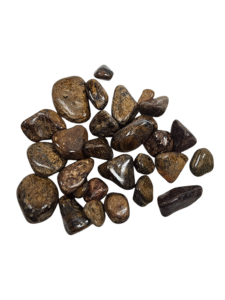
Bronzite is a crystal that belongs to the pyroxene group and is closely related to enstatite and hypersthene, showing a composition that includes iron and sometimes copper which creates a bronze tone on the surface. This natural stone is known for a warm and earthy texture, and each raw piece can vary in size, polish and overall quality depending on the locality where the deposit is found. Many samples from Brazil and the Czech Republic, for example, display a strong and unique character that makes them highly valued as decorative material. The surface often shows a gold like reflection that gives an image of warmth and depth when viewed closely. Collectors often reference its physical property as a symbol of inner strength, calm determination and confidence in difficult situations. This variety is often treated as a perfect selection for those who seek a greater sense of protection and focus. A highly regarded stone, it continues to enhance displays and remains truly admired for its class and rich texture. In this guide, you will learn more about this great stone. Let’s begin!
Bronzite meaning
Grounded energy: Bronzite is often described as a mineral that could bring a sense of balance during moments of daily change. It is known for its earthy presence that may support personal grounding when routines feel different. Many people value its ability to hold a calm energy that feels steady through shifting circumstances. Bronzite is regarded as a stone that may help someone focus inward when life feels busy or unclear. Over time it has been kept close for its connection to a centered state of mind.
Reflection: Those who work with bronzite describe it as a crystal that could help with maintaining attention on inner thoughts without distraction. It is seen as something that may support long moments of reflection when choices seem complex. Some mineral collectors speak of it as a stone that carries a vibration that feels calm over long periods. Bronzite has been appreciated for creating an atmosphere where self-observation feels easier. It may offer a space that feels less chaotic.
Protection: Within many guides bronzite is written about as a crystal that could create a field of protection that feels constant and secure. People sometimes keep it with other stones to strengthen a sense of security in personal spaces. And, its reputation comes from many traditions that see it as a mineral that holds energy without fading quickly. Some say its presence may make a room feel steady even when outside activity changes. Bronzite is often kept for its lasting qualities.
Calm strength: Over time bronzite has been known in metaphysical records as a mineral that could bring calm strength when emotions feel unsettled. It has been mentioned in collections that show its use in maintaining a balanced environment. Many consider it part of routines where quiet strength is valued above reaction. Its steady nature may help maintain focus on long term goals without outside noise. Bronzite is kept in many spaces where stillness and structure are seen as important.
Bronzite spiritual meaning
Connection to peace: Bronzite is spoken of in spiritual writings as a crystal that may hold an energy linked to inner peace and quiet thought. It has been mentioned as part of practices where calm surroundings are valued for steady reflection. Many people keep it nearby in places where they wish to spend time in mindful silence. Over many years it has been regarded as a mineral that carries a presence that feels constant during spiritual focus. Bronzite is known for this steady character.
Link to higher awareness: In various records bronzite is described as a stone that may support a sense of higher awareness during spiritual moments. It has been regarded as something kept close when one wishes to remain attentive to deeper understanding. Many accounts describe it as part of a collection of stones used for thoughtful states. Over time it has gained respect as a mineral that remains stable while spiritual work continues. Bronzite is often noted for this lasting quality.
Who should wear bronzite?
Those who seek to feel steady in moments of uncertainty often choose bronzite as part of their daily wear because it is known for its grounding reputation. People who work in places with constant changes or decisions sometimes keep it near them since it is connected to maintaining focus. Many individuals in environments where routines shift regularly find it meaningful to wear bronzite throughout the day so its presence remains close during those times.
Individuals who value a calm state of mind during personal reflection often wear bronzite to keep that atmosphere around them. Those who spend time in thoughtful practices or who want to remain centered while handling different responsibilities often keep bronzite as part of their jewelry or in a pocket. It has been chosen by people who appreciate a mineral known for its steady qualities and who wish to feel connected to that energy while moving through daily tasks.
Where is bronzite found?
Germany: In Germany, bronzite has been recorded in regions known for igneous rock formations where pyroxene minerals are common. Many specimens have been documented from areas that were historically active in mining and geological studies. These locations are well known for producing material with a strong metallic surface and good structural integrity. Researchers have noted that certain German localities continue to provide samples collected for both educational and commercial use.
South Africa: South Africa is recognized as a major source of bronzite that is often exported for use in jewelry and decorative objects. Large deposits are situated in areas where ancient geological activity shaped iron rich rocks. Several well known mines have produced notable pieces that show a consistent color and texture. These materials have been carefully cataloged in various collections and remain a common reference for mineral studies.
United States: Within the United States bronzite has been reported in several states that contain extensive igneous and metamorphic terrains. Areas with a history of mineral exploration often hold small to medium sized deposits. Some regions are better known for producing high quality examples that are cut and polished for collectors. Geological surveys in the country continue to list bronzite as part of documented mineral resources.
Other Areas: Beyond these main regions bronzite can also be found in countries such as Norway Brazil and India where similar rock types are present. These areas produce varied qualities of material that are gathered for both local and international markets. Each locality contributes unique samples that differ in texture and surface appearance. Records from mineralogists describe these findings as part of broader research on pyroxene minerals.
How rare is bronzite?
Bronzite is not considered one of the rarest minerals, but it is not found everywhere in large amounts. It appears most often in igneous rocks and is recognized as a common member of the pyroxene group. Many mineral collections include bronzite because it is available through known deposits that have been documented in several countries. Even though it is not classified as extremely scarce, high quality material with a polished appearance is less common than ordinary rough fragments.
Large deposits of bronzite have been recorded in regions that are well studied by geologists and many pieces have been extracted over the years. Certain areas, for instance, produce material that is better for cutting into cabochons or beads, while others only yield smaller sections. The overall supply of bronzite is stable because it forms naturally in areas where volcanic activity shaped the land. It is widely recognized and traded but not viewed in the same category as very rare gemstones.
What is difference between Bronzite and Tiger’s Eye?
| Feature | Bronzite | Tiger’s Eye |
|---|---|---|
| Mineral Group | Bronzite is a member of the pyroxene group and is classified as an orthopyroxene variety rich in iron. | Tiger’s Eye is a variety of quartz that forms through the alteration of crocidolite fibers within silica. |
| Appearance | Bronzite shows a brown surface with a metallic like sheen and can display fine reflective layers when polished. | Tiger’s Eye shows a golden brown tone with a fibrous structure that creates a moving light effect known as chatoyancy. |
| Formation | Bronzite forms within igneous rocks where high temperature and pressure allow iron rich minerals to develop. | Tiger’s Eye forms when quartz slowly replaces amphibole fibers while preserving the fibrous pattern over time. |
| Common Use | Bronzite is often cut into cabochons or beads for jewelry and is also kept as polished stones in collections. | Tiger’s Eye is widely used in jewelry such as pendants and rings and is also carved into decorative objects. |
| Localities | Bronzite can be found in regions such as Germany, South Africa, the United States and several other areas. | Tiger’s Eye is mainly obtained from South Africa, Western Australia and other locations with large quartz deposits. |
Bronzite properties
| Property | Bronzite | Tiger’s Eye |
|---|---|---|
| Chemical Composition | (Mg,Fe)2Si2O6 as a member of the orthopyroxene group containing iron and magnesium | SiO2 as a quartz variety containing parallel fibers of crocidolite replaced by silica |
| Color | Typically brown to dark brown with a metallic reflective surface and golden flecks | Golden to reddish brown with a fibrous shimmer and strong light reflection |
| Luster | Submetallic to vitreous when polished | Silky to vitreous with a moving band of light |
| Hardness (Mohs) | 5 to 6 | 6.5 to 7 |
| Crystal System | Orthorhombic | Trigonal |
| Cleavage | Two directions that are distinct but not perfect | No true cleavage, shows splintery fracture |
| Specific Gravity | 3.3 to 3.4 | 2.6 to 2.7 |
| Transparency | Opaque | Usually opaque |

