Hazu Tonalite may look like an ordinary grey and black stone at first glance, but its dense structure formed deep within Japan tells a much deeper story beneath the surface. Because of this, it makes it a standout material that many associate with confidence, focus, peace, and decisiveness when placed throughout interior living spaces or outdoor environments where personal intention and direction play an important role. In today’s guide, let’s dive deep and see what Hazu Tonalite is all about.
Hazu Tonalite meaning
Supports focus: Hazu Tonalite is often connected with maintaining attention and directing personal energy toward tasks and goals, creating a sense of internal balance that allows intention to remain present throughout daily routines while helping maintain mental clarity within busy or demanding environments.
Builds confidence: This material is commonly associated with strengthening personal assurance by supporting a stable internal mindset, allowing for a deeper sense of security to develop over time which may connect with confidence in decision making across work or in your home life.
Encourages peace: Hazu tonalite is a grounding material formed through central magmatic processes within the Hazu region of Japan where minerals such as plagioclase, quartz, feldspar, amphibole, and biotite combine with traces of zircon, apatite, pyrite, ilmenite, and magnetite combine. This creates a grey and black presence that is said to support peace and focus through its energy.
What is Hazu Tonalite?
Hazu Tonalite is a natural igneous rock that forms deep within the earth as molten material slowly cools over long periods of time, creating a dense stone made up of interlocking mineral grains that give it a speckled and layered appearance across its surface while commonly displaying gray, off white, and muted black tones throughout the material.
This stone belongs to the tonalite family of intrusive rocks that develop beneath the earth’s surface under high heat and pressure, allowing larger crystal structures to grow slowly within the material which results in natural variations in pattern and tone from piece to piece while maintaining a solid feel and consistent texture when shaped into slabs, carvings, or polished forms.
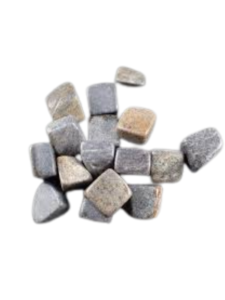
Where is Hazu Tonalite found?
Hazu Tonalite is mainly found in Japan within the Hazu region of Aichi Prefecture, where tonalite formations developed deep below the surface and later became exposed through geological uplift and natural erosion over long spans of time.
Stone from this area is typically extracted from localized quarry sites that cut into intrusive tonalite bodies which formed under high pressure conditions, resulting in dense material that shows mineral blending across gray and off white surfaces with darker mineral presence throughout.
NOTE: Outside of Japan, tonalite deposits can also be located in smaller intrusive formations found in parts of North America and Europe, although Hazu Tonalite specifically refers to material sourced from the Hazu area where the original tonalite mass is known for its uniform grain structure and consistent mineral distribution.
Hazu Tonalite properties
| Property | Hazu Tonalite |
|---|---|
| Rock type | Intrusive igneous rock in the tonalite family |
| Texture | Crystalline with interlocking mineral grains |
| Grain size | Usually medium to coarse grain |
| Main minerals | Plagioclase feldspar and quartz with smaller amounts of darker minerals |
| Typical appearance | Light gray to off white base with darker speckling and natural pattern movement |
| Luster when polished | Low to moderate shine depending on finish quality |
| Hardness | Commonly around Mohs 6 to 7 due to feldspar and quartz content |
| Density | Often around 2.6 to 2.8 g/cm³ for tonalite type material |
| Cleavage | No single cleavage across the whole rock, individual minerals may show cleavage |
| Fracture | Irregular break surfaces from mixed minerals |
| Porosity | Generally low porosity due to tight grain locking |
| Durability | Tough and wear resistant for everyday handling, edges can chip if dropped |
| Weathering behavior | Can slowly break down over long time spans as feldspar alters at the surface |
| Common lapidary uses | Slabs, tiles, carvings, palm stones, and decorative polished pieces |
| Care | Clean with mild soap and water, avoid harsh acids and strong abrasive cleaners |

