Dallasite stands out as one of those stones that quietly pulls attention without trying too hard. Its bold mix of textures, fragments, and mineral contrasts gives it a look that feels raw, layered, and full of depth. Often talked about in gem circles yet still unfamiliar to many collectors, Dallasite sits at the crossroads of geology and lapidary appeal. The more you notice its details, the more its story feels complex, visual, and hard to ignore. In today’s guide, let’s explore Dallasite in detail.
Dallasite meaning
Grounded awareness: Dallasite is often connected with a grounded sense of awareness that feels practical and calm. Its mixed appearance may relate to feeling present while staying aware of different thoughts or emotions moving through everyday life in a natural way.
Inner balance: This stone is commonly linked with balance that feels organic rather than forced. Dallasite may reflect the idea of holding contrasting feelings at the same time all while allowing them to exist together without tension of sorts.
Emotional processing: Dallasite is often associated with emotional processing that unfolds slowly and naturally. Its layered patterns, for instance, may suggest moving through emotions at a comfortable pace while allowing clarity to form over time.
Connection to natural rhythms: Dallasite is frequently tied to a sense of connection with natural rhythms and cycles. It may symbolize noticing changes, transitions, and personal shifts while remaining grounded in ordinary routines and daily experiences.
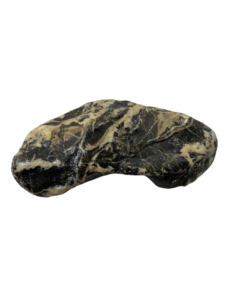
Where is Dallasite found?
Dallasite is found exclusively in Canada, where it is considered a true local stone rather than a widespread material. All known specimens trace back to a small coastal area in British Columbia, with no verified finds reported in other countries.
British Columbia
Within Canada, Dallasite occurs in British Columbia, specifically along the southern portion of Vancouver Island. The stone appears in coastal volcanic rock that has been naturally exposed by erosion rather than through mining activity.
Vancouver Island
Dallasite is associated with southern Vancouver Island, where altered basalt and mixed volcanic material are visible along shoreline outcrops. These conditions allow the stone to be found at the surface instead of deep underground.
Victoria Area
The city of Victoria is the main urban location connected to Dallasite. Most material originates from nearby coastal exposures rather than inland areas or structured excavation sites.
Dallas Road
The most well known source is Dallas Road, a coastal roadway where wave action and weathering reveal Dallasite directly in shoreline rock formations. There are no formal mines associated with this location, as collection occurs from naturally exposed surfaces.
Dallasite price
Dallasite prices can vary based on size, quality, and how it is shaped. Small tumbled pieces often range from $5 to $20 each. Cabochons that are polished for jewelry can range from $20 to $80 depending on size and finish. Larger display pieces that are cut and polished can range from $80 to $250 or more based on dimensions and appearance. Collector grade slabs or unique specimens that show intricate patterns can range from $250 to $600 or more depending on rarity and size. Overall Dallasite prices move along these ranges depending on how the material is presented and the preferences of buyers.
What is it?
Dallasite is a type of volcanic rock that is used as a mineral and gem material rather than a single defined mineral species. It is often described as a gemstone material made from complex volcanic processes, combining multiple components into one visually striking rock. Dallasite is considered an unofficial stone and is closely tied to regional identity, often referenced as the unofficial stone connected to a capital city rather than a formally recognized designation.
From a geological standpoint, Dallasite formed through underwater volcanic activity and is associated with pillow basalt, pillow lava, and hyaloclastite. It developed within Triassic volcanic systems and is linked to large scale volcanic events such as the Karmutsen flood basalts. The material commonly includes altered volcanic fragments and shards mixed with minerals like chlorite, pumpellyite, carbonate, and jasper breccia, giving it a varied and complex structure.
As a gemstone material, Dallasite is valued for its durability and visual complexity rather than crystal clarity. It is considered an important gem material and is often ranked among the more significant regional gem materials due to its distinctive volcanic origin and mixed mineral composition.
Dallasite properties
| Property | Dallasite |
|---|---|
| Type | Rock, lapidary material |
| Composition | Mixture of altered volcanic rock with multiple minerals |
| Crystal system | None as a whole rock, individual minerals inside may vary |
| Color | Green, red, brown, black, white, cream, gray |
| Pattern | Mottled, brecciated, swirled, patchy, veined |
| Luster | Waxy to vitreous after polish, variable by mineral mix |
| Transparency | Opaque |
| Grain | Fine to medium, sometimes mixed textures |
| Hardness | About 5.5 to 7 on the Mohs scale, varies by area |
| Toughness | Fair to good, some areas may undercut during polishing |
| Fracture | Uneven to conchoidal in harder sections |
| Cleavage | None overall, individual minerals inside may show cleavage |
| Streak | Not consistent, depends on the mineral content |
| Specific gravity | Variable, commonly around 2.7 to 3.1 depending on mix |
| Common forms sold | Tumbles, cabochons, slabs, palm stones, freeforms, jewelry |
| Typical polish result | High polish in harder zones, mixed finish where softer zones occur |

